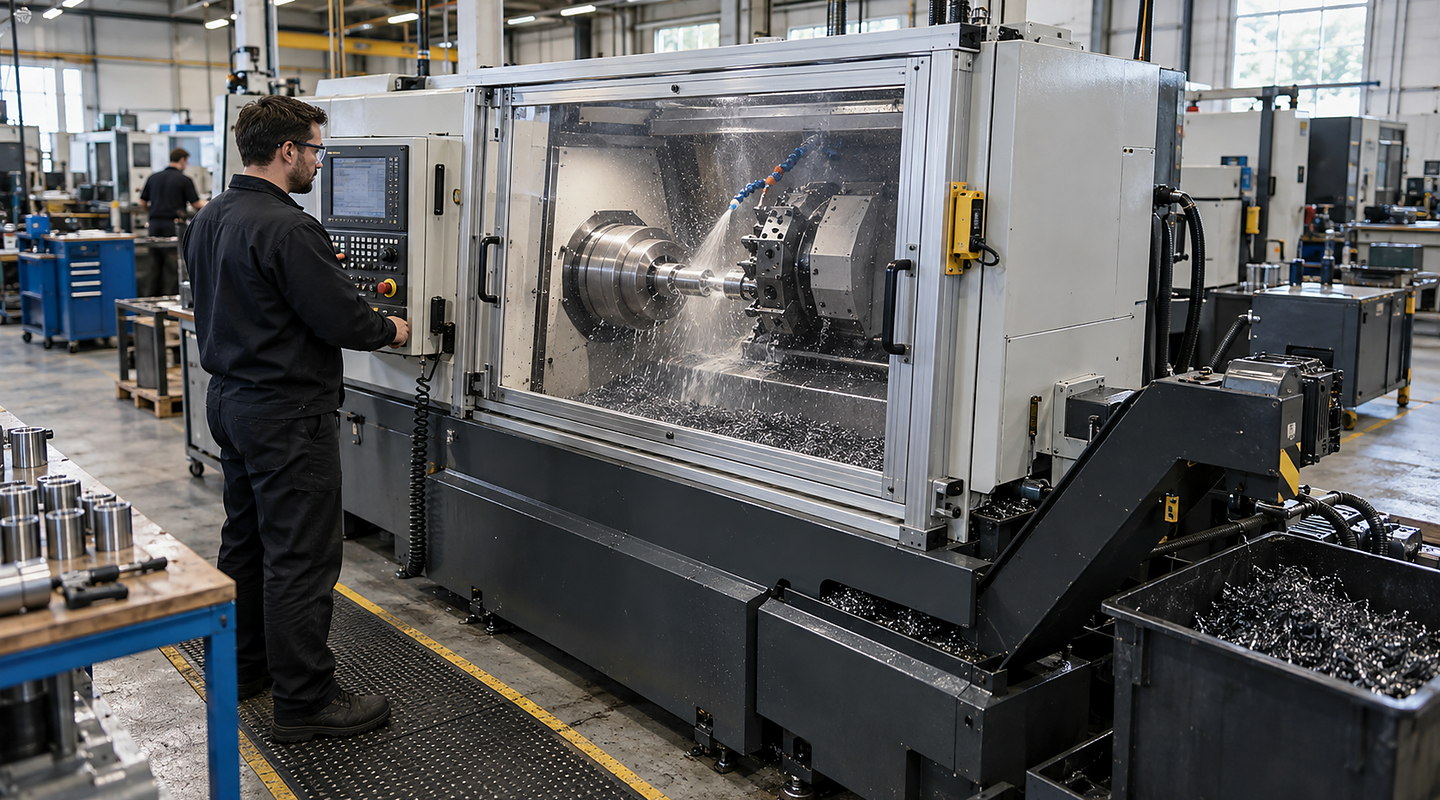
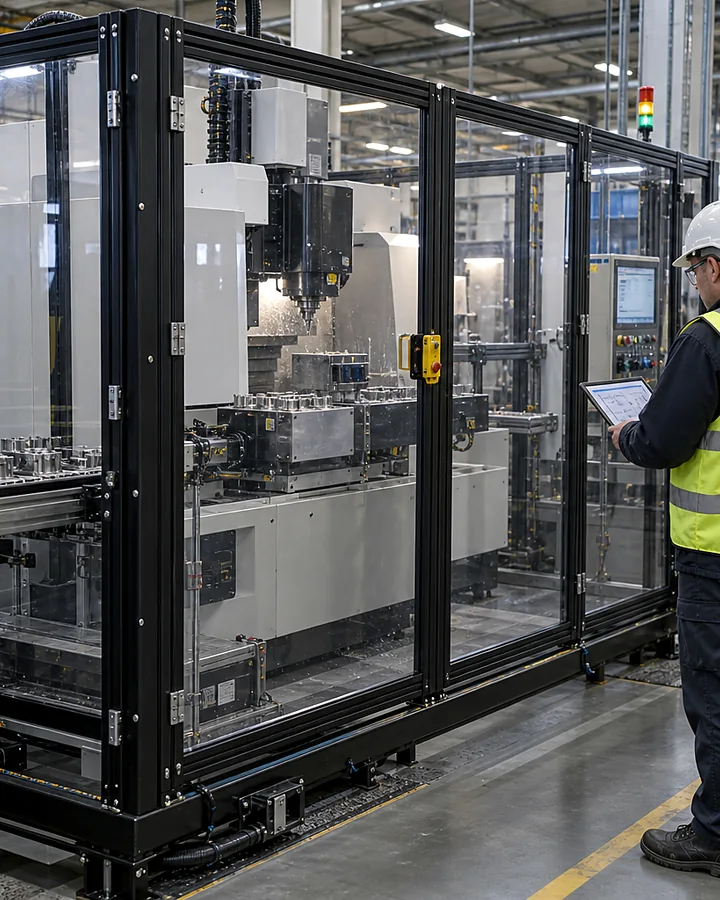
A coupling-guard brief needs more than the coupling's dimensions. Share the drive layout, motion, foreseeable access and maintenance tasks so a fabricated guard can be reviewed in the context of the complete machine and its validation requirements.
Speak directly with Oxford Machine Guarding about bespoke shaft-coupling guard fabrication.
Quick answer
What measurements are needed for a bespoke coupling guard?
Record the coupling, shafts and nearby bearings, including the available mounting points and the full operating envelope. Photograph the installation with a scale and mark inspection or maintenance access. The proposed guard should account for supports, clearances and removal as part of the assessed machine arrangement.
Application decisions
Design the guard around the complete coupling installation
A fabricated coupling cover must suit the shafts, adjacent equipment, supports and access tasks. Start with a machine survey and risk assessment; dimensions from an exposed coupling alone do not establish a suitable safeguarding arrangement.
Capture the full rotating envelope
Record both shafts, coupling halves, fasteners and adjacent bearings from a safe, isolated survey. Include foreseeable movement and the manufacturer's relevant machine information. The guard outline should be reviewed against the complete rotating assembly, not only the nominal coupling diameter.
Show how the guard will be supported
Identify proposed mounting surfaces, existing holes, base frame and obstructions. Confirm who will assess the strength and suitability of the supports. A close-fitting cover with weak or impractical attachments is not a complete fabrication specification.
Separate observation from intervention
List tasks that only require visibility and tasks requiring physical access. Consider inspection, lubrication, alignment and coupling replacement individually. This helps establish whether an observation provision or removable section is appropriate without creating an unassessed route to moving parts.
Plan removal and reinstatement
Describe how an isolated machine will be accessed for maintenance, where the removed guard will be placed and how it is refitted. Include fixings and the space needed to remove the largest part. Make the final fit and reinstatement check part of the maintenance instructions.
Select construction for the environment
Identify cleaning methods, moisture, corrosion, temperature and foreseeable impact or ejection. Compare visibility, containment and durability against those conditions. Mesh, sheet and clear panels serve different purposes; material selection and openings need assessment for this particular machine.
Review the installed boundary
Check gaps around shafts, pipework and nearby structures in the installed arrangement. Include access from the sides and underneath, not only the usual viewing position. Agree inspection and any control-system validation required before the modified machine returns to use.
Two useful starting points for coupling guard fabrication
The right choice changes with hazards and foreseeable access for bespoke shaft-coupling guard fabrication, machine motion and stopping behaviour, your line layout and required results.
Carry the application decisions into a documented review and an agreed test or inspection plan.
01
Survey safely
Capture drive geometry, mounting points and tasks under the site's safe isolation arrangements.
02
Review the guard concept
Agree access, materials, fixings and the boundary with adjacent machine parts.
03
Check the fabrication against the machine
Resolve physical fit and maintenance clearance before final acceptance.
04
Document reinstatement
Retain drawings and the inspection, removal and refitting information required for the installation.
Important limits
Know what needs a separate check
Current standards and required performance levels must be assessed for the complete machine and intended use.
A site survey and task-based risk assessment are required before a safeguard is selected.
Mechanical changes can affect access, visibility, cleaning and machine operation.
Your final solution for bespoke shaft-coupling guard fabrication must reflect the law, current standards and site-specific risks that apply to your installation.